 Newletters
 Contact


 VN
VNDiscover how the OMICRON CT Analyzer transforms current transformer testing with advanced modeling, high accuracy, automated multi-ratio testing, and full IEC/IEEE compliance.
1. Introduction to Modern Current Transformer (CT) Testing
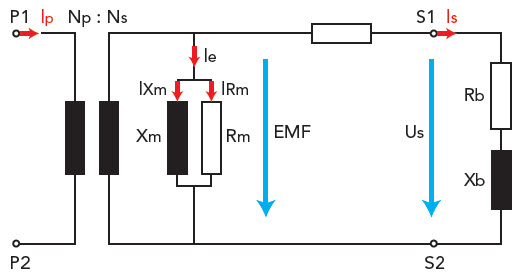
Current transformers are fundamental components in every power system, supplying accurate current information for protection relays and metering devices. While both types share the same electrical principle, protection CTs and metering CTs have very different operational requirements:
-
Protection CTs must remain accurate even during fault conditions where the primary current may reach 20–30 times the nominal level.
-
Metering CTs require extremely high accuracy at rated current and must quickly saturate above nominal to protect downstream meters.
To ensure long-term reliability and precise performance, CTs must be tested throughout their lifecycle—from manufacturing and commissioning to periodic maintenance. Traditional methods, however, often fail to deliver the depth and precision needed in modern power systems.
2. The Limitations of Traditional CT Testing Methods
2.1 Primary Injection (High-Current Test)
Primary injection applies a large current on the primary winding while measuring the secondary output.
Limitations:
-
Requires heavy, high-capacity current sources
-
Very time-consuming
-
Often impractical for CTs with very high knee points (e.g., TP class CTs)
-
Not ideal for on-site testing due to power and safety constraints
2.2 Secondary Voltage Injection
This method applies a test voltage at the secondary winding to generate part of the excitation curve.
Limitations:
-
Maximum test voltage ~2 kV
-
Inability to measure key parameters such as:
-
ALF (Accuracy Limit Factor)
-
FS (Safety Factor)
-
Composite error
-
Transient dimensioning factor
-
-
Cannot simulate real fault behavior or transient responses
-
Unsuitable for high-accuracy metering CTs
➡️ Conclusion: Traditional methods do not provide a complete or reliable assessment of CT performance.
3. The New Approach: CT Modeling with the OMICRON CT Analyzer
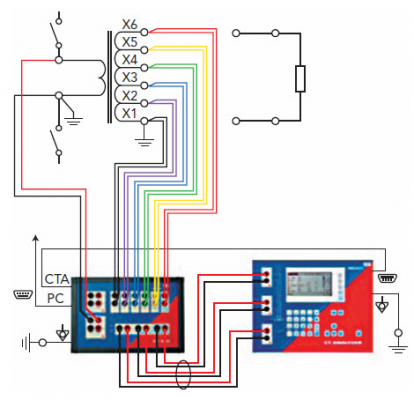
The OMICRON CT Analyzer introduces a revolutionary testing concept based on accurate mathematical modeling. Instead of injecting high current or high voltage, the device performs advanced low-voltage measurements and uses them to build a complete digital model of the CT.
The CT Analyzer models key CT parameters including:
-
Secondary winding resistance (Rct)
-
Iron losses (eddy current and hysteresis losses)
-
Magnetic saturation characteristics (knee point)
-
Excitation curve
-
ALF / FS / Burden effects
-
Transient dimensioning factor (IEC 60044-6 / IEC 61869-2)
-
Residual magnetism
-
Inductance values (saturated / unsaturated)
-
Overcurrent behavior
This modeling-based approach allows engineers to simulate the CT’s exact behavior under different burdens, fault currents, and system conditions.
4. Key Advantages of the OMICRON CT Analyzer
4.1 High Testing Accuracy
-
Ratio error: 0.05% (0.02% typical)
-
Phase displacement: 3 minutes (1 minute typical)
-
Verified by renowned metrology institutes (PTB, KEMA, Wuhan HVRI, NIST, etc.)
-
Suitable for metering CTs up to Class 0.1 and 0.15
4.2 Fast and Fully Automated Testing
-
Complete CT testing in seconds
-
Automatic reporting based on IEC 60044-1, IEC 61869-2, IEEE C57.13
-
Instant digital reports ideal for commissioning and maintenance teams
4.3 Automated Multi-Ratio CT Testing with CT SB2
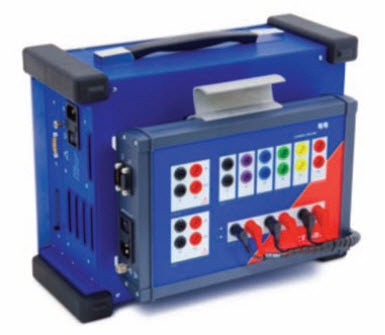
When paired with the CT SB2 Switch Box, the OMICRON CT Analyzer can:
-
Test up to six CT ratio taps automatically
-
Eliminate the need for rewiring
-
Limit test voltage to < 200 V for safer operation
-
Greatly speed up field testing in substations and factories
4.4 Residual Magnetism Measurement and Demagnetization
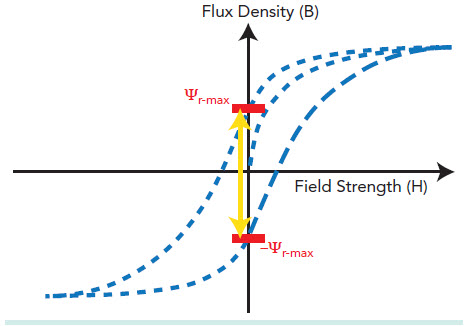
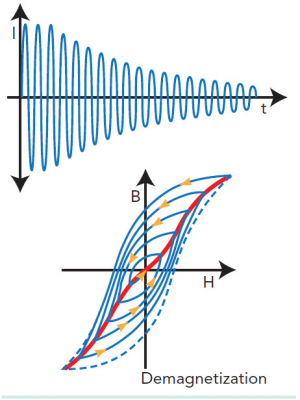
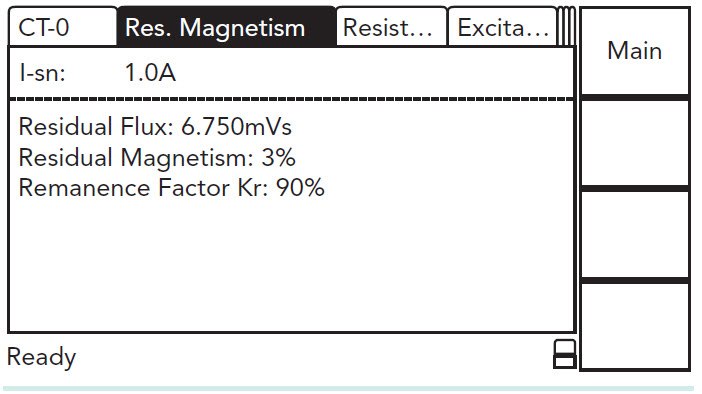
Using its RemAlyzer feature, the CT Analyzer can:
-
Detect residual flux (remanence)
-
Identify CTs affected by system faults or polarity tests
-
Automatically demagnetize the CT
-
Prevent relay misoperation caused by core saturation
Residual magnetism is a leading cause of false differential relay trips—making this feature critical for protection engineers.
5. Engineering Applications and System Integration
The complete digital CT model generated by the OMICRON CT Analyzer can be exported to:
-
Power system simulation tools
-
Relay coordination and fault studies
-
Short-circuit analysis
-
Digital substation engineering (IEC 61850)
-
Protection system troubleshooting
-
Event and disturbance reconstruction
This ensures engineers understand exactly how a CT behaves under fault conditions—especially during deep saturation—allowing for more accurate protection system design.
6. Conclusion
With CTs expected to operate reliably for 30+ years, high-accuracy testing has never been more important. The OMICRON CT Analyzer provides:
-
Superior accuracy
-
Faster testing workflows
-
Automated multi-ratio verification
-
Full IEC/IEEE compliance
-
Residual magnetism analysis
-
A complete CT digital model enabling fault and protection simulations
Thanks to its modeling-based approach, the OMICRON CT Analyzer sets a new global standard in CT testing for utilities, manufacturers, EPC firms, and service providers.